A Gambaran Kadar Kolesterol LDL Berdasarkan Frekuensi Konsumsi Junk Food pada Mahasiswa
DOI:
https://doi.org/10.37012/anakes.v12i1.3569Abstract
The rise in the use of online food ordering services has influenced people’s eating habits, including an increase in junk food consumption among college students. Junk food is high in saturated fat, sugar, and salt, which can potentially raise LDL levels and trigger health problems. LDL cholesterol is often referred to as “bad” cholesterol because it tends to stick to the walls of blood vessels, which over time can harden and form plaque (atherosclerosis), thereby blocking the blood vessels. This study aims to analyze LDL levels in college students based on their junk food consumption patterns via online ordering. The study employed an experimental design with a quantitative approach involving 60 students selected using purposive sampling. Data on the frequency of junk food consumption were collected via a questionnaire, while LDL level measurements were conducted using a TMS 30i chemistry analyzer with the direct method. The results showed that the group with the highest frequency of junk food consumption was 2 times per week, comprising 25 respondents (41.7%). The highest average LDL level was found in the group consuming junk food 7 times per week at 155 mg/dL, and the lowest average LDL level was in the group consuming it 4 times per week at 99.89 mg/dL. The results of the One-Way ANOVA test showed a significance value of 0.316 (p > 0.05), indicating no significant difference between LDL levels and the frequency of junk food consumption. Students are advised to adopt a healthy diet, and future research should consider other factors influencing LDL levels.
Keywords: Frequency of Junk Food Consumption, Junk food, LDL, Ordering Online
Downloads
Published
How to Cite
Issue
Section
Citation Check
License
Copyright (c) 2026 Nabila Aprilia, Havida Widyastuti, Arifiani Agustin Amalia

This work is licensed under a Creative Commons Attribution 4.0 International License.
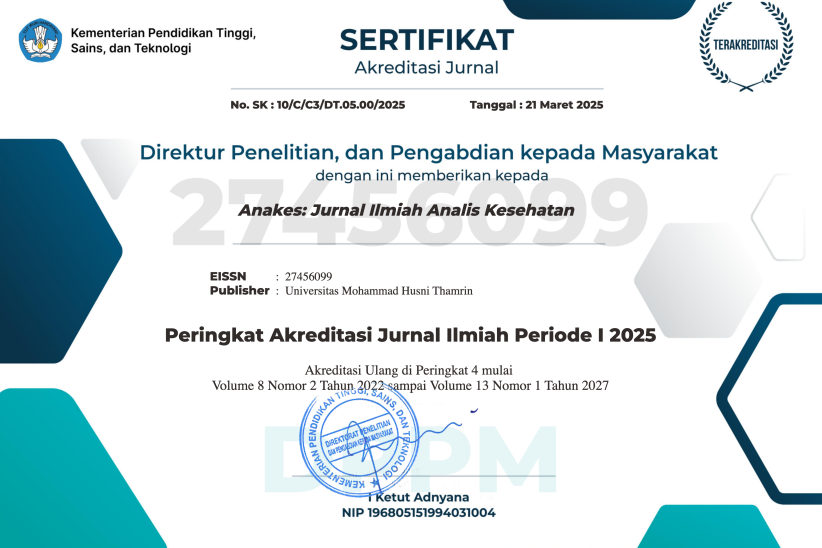
Anakes :Â Jurnal Ilmiah Analis Kesehatan allows readers to read, download, copy, distribute, print, search, or link to the full texts of its articles and allow readers to use them for any other lawful purpose. The journal allows the author(s) to hold the copyright without restrictions. Finally, the journal allows the author(s) to retain publishing rights without restrictions Authors are allowed to archive their submitted article in an open access repository Authors are allowed to archive the final published article in an open access repository with an acknowledgment of its initial publication in this journal.

Lisensi Creative Commons Atribusi 4.0 Internasional.