Application of the SAW Method to Determine Priority Candidates for the KIP-K Program at SMK Miftahul Ulum
DOI:
https://doi.org/10.37012/jtik.v12i2.3983Abstract
The selection process for Kartu Indonesia Pintar Kuliah (KIP-K) candidates at SMK Miftahul Ulum, Tasikmalaya Regency, has historically been conducted subjectively by homeroom teachers without a structured assessment mechanism, potentially leading to recommendations that lack objectivity. This study employs a quantitative approach using the Simple Additive Weighting (SAW) method for multi-criteria decision-making. The research stages include problem identification, literature review, data collection, determination of criteria and weights, decision matrix construction, matrix normalization, preference value calculation, alternative ranking, and result interpretation. The study also applies the SAW method to develop a Decision Support System (DSS) to determine KIP-K candidate priorities in a measurable, data-driven manner. Data were collected through observation and structured interviews with 40 Grade XII students using a saturated sampling technique. Four criteria were established based on official requirements from Puslapdik Kemendikdasmen: PIP ownership (35%), parental income (30%), number of family dependents (20%), and academic grades (15%). Ranking results indicate that Kiki Haolotul Lasmini holds the top rank (Vi = 0.9553), followed by Indah Nurul Hidayati (Vi = 0.9153) and Rifqi Kurniawan (Vi = 0.9011). All 11 students who are PIP recipients dominate the top 11 rankings. The SAW method proved capable of producing a priority ranking that is systematic, transparent, and accountable, serving as a sound basis for selecting KIP-K candidates at the vocational high school (SMK) level.
Downloads
Published
Issue
Section
Citation Check
License
Copyright (c) 2026 Yahdi Kusnadi, Muhamad Ichsan Rais

This work is licensed under a Creative Commons Attribution 4.0 International License.
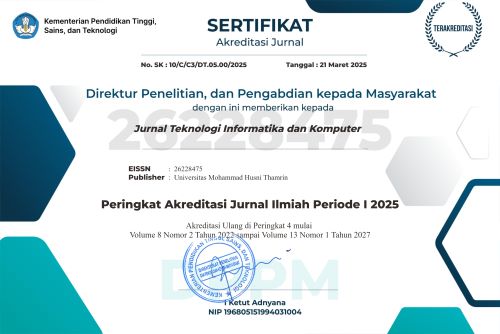
Jurnal Teknologi Informatika dan Komputer allows readers to read, download, copy, distribute, print, search, or link to the full texts of its articles and allow readers to use them for any other lawful purpose. The journal allows the author(s) to hold the copyright without restrictions. Finally, the journal allows the author(s) to retain publishing rights without restrictions Authors are allowed to archive their submitted article in an open access repository Authors are allowed to archive the final published article in an open access repository with an acknowledgment of its initial publication in this journal.

Jurnal Teknlogi Informatika dan Komputer is licensed under a Creative Commons Attribution 4.0 International License.