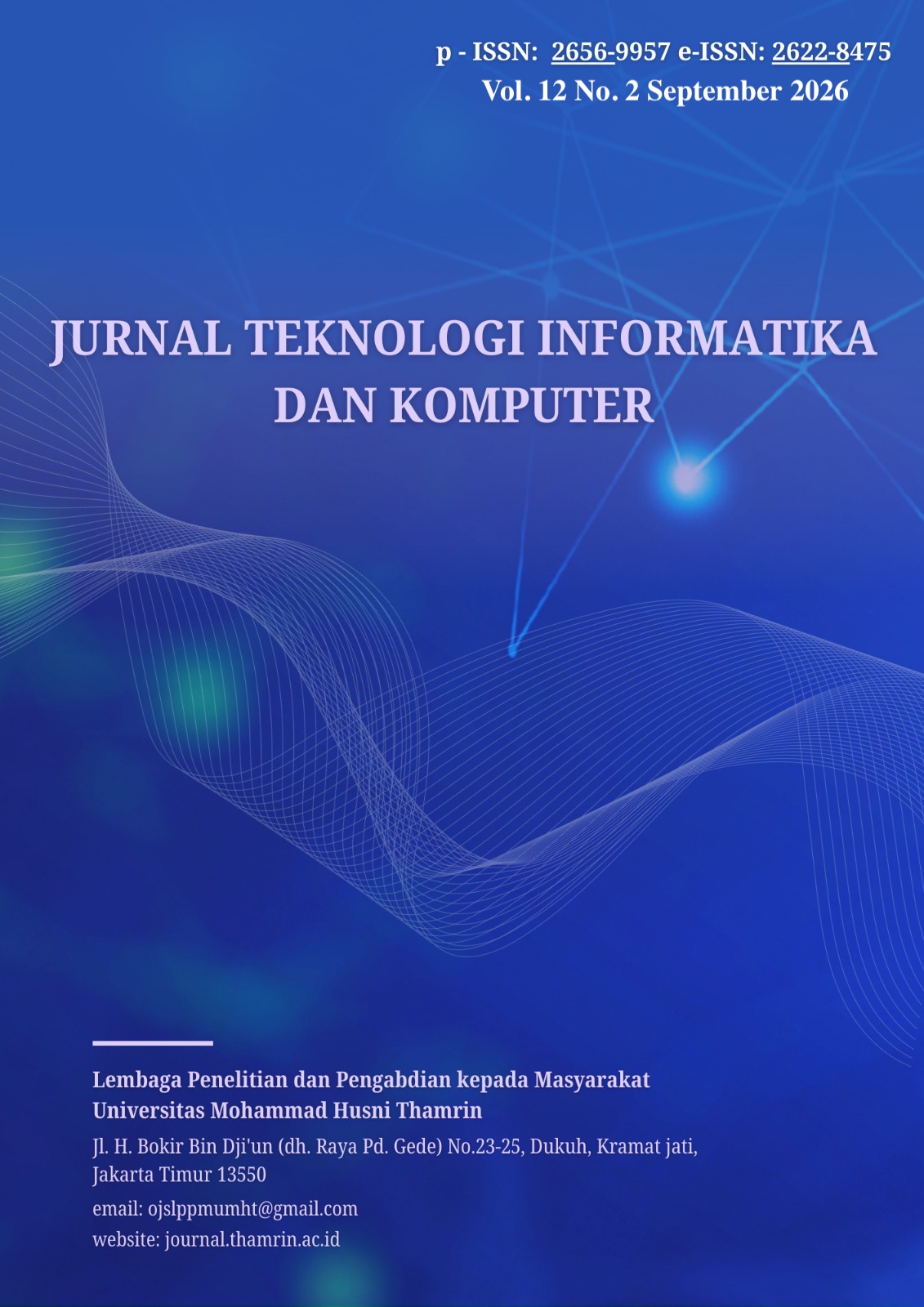
Diabetes Mellitus Detection System Using Machine Learning with the Support Vector Machine (SVM) Method
DOI:
https://doi.org/10.37012/jtik.v12i2.3596Abstract
Background: Diabetes Mellitus (DM) remains a major non-communicable disease with a continuously rising prevalence, and delayed diagnosis increases the risk of severe complications such as kidney failure, cardiovascular disease, and neuropathy. Objective: This study aims to design and build a web-based Diabetes Mellitus detection system using the Support Vector Machine (SVM) algorithm and to measure the classification performance of the resulting model. Methods: The dataset consisted of 170 medical records from Rumah Sakit Cut Meutia collected over the 2023-2025 period, comprising eight predictor variables (gender, blood pressure, glucose level, insulin, skin thickness, Body Mass Index, diabetes family-history score, and age). The data were preprocessed through label encoding, median-based missing-value imputation, Interquartile Range (IQR) outlier clipping, and Min-Max normalization, then split into 80% training data (132 records) and 20% testing data (34 records). The SVM model, comparing Linear and Radial Basis Function (RBF) kernels, was optimized using GridSearchCV with Stratified 5-Fold Cross Validation. Results: The optimal model used an RBF kernel with C = 1 and gamma = 0.01, achieving a cross-validation ROC-AUC of 96.43%. On the test set, the model achieved an accuracy of 88.24%, precision of 94.12%, recall of 84.21%, and an F1-score of 88.89%, with a test-set AUC of 96.1%. Usability testing using the System Usability Scale (SUS) on 10 respondents produced an average score of 71.75, placed in the "Good" category. Conclusion: The SVM-based web system was able to classify Diabetes Mellitus status accurately and was assessed by users as easy to operate, indicating its feasibility as a decision-support tool for the early detection of Diabetes Mellitus.
Downloads
Published
Issue
Section
Citation Check
License
Copyright (c) 2026 Syahira Ratu Fadilla, Sayed Fachrurrazi, Desvina Yulisda

This work is licensed under a Creative Commons Attribution 4.0 International License.
Jurnal Teknologi Informatika dan Komputer allows readers to read, download, copy, distribute, print, search, or link to the full texts of its articles and allow readers to use them for any other lawful purpose. The journal allows the author(s) to hold the copyright without restrictions. Finally, the journal allows the author(s) to retain publishing rights without restrictions Authors are allowed to archive their submitted article in an open access repository Authors are allowed to archive the final published article in an open access repository with an acknowledgment of its initial publication in this journal.

Jurnal Teknlogi Informatika dan Komputer is licensed under a Creative Commons Attribution 4.0 International License.