East Java Inflation Prediction Based on Exchange Rates and International Trade Using the ARIMAX Approach
DOI:
https://doi.org/10.37012/jtik.v12i1.3287Abstract
East Java's macroeconomic stability is vulnerable to external shocks, particularly imported inflation, which impacts domestic price formation. This study aims to develop an inflation forecasting model using the AutoRegressive Integrated Moving Average with Exogenous Variables (ARIMAX) approach as an Early Warning System instrument for regional policymakers. This study uses monthly time series data for the 2015–2024 period. Exogenous variable selection was conducted through the Granger Causality Test, which showed that only import volume had a significant effect on inflation, while exchange rates and exports were insignificant. The estimation results show that the ARIMAX(1,0,1) model is the best model with a forecasting accuracy level based on the Mean Absolute Percentage Error (MAPE) value of 10.40%, which is categorized as good. East Java's inflation projection for the 2025–2029 period shows an increasing trend from 1.99% to 3.28%, indicating the need for vigilance for policymakers in strengthening import supply chain management to mitigate the risk of future price pressures. Based on the theoretical and empirical review, this study hypothesizes that the exchange rate and international trade indicators have a significant predictive relationship with the inflation rate in East Java Province. This study aims to develop an inflation forecasting model for East Java using the ARIMAX approach, considering the exchange rate and international trade variables as candidate exogenous variables.
Downloads
Published
Issue
Section
Citation Check
License
Copyright (c) 2026 Nafisah Zahrotun, Rizky Aditya Nugroho, Awang Andhyka

This work is licensed under a Creative Commons Attribution 4.0 International License.
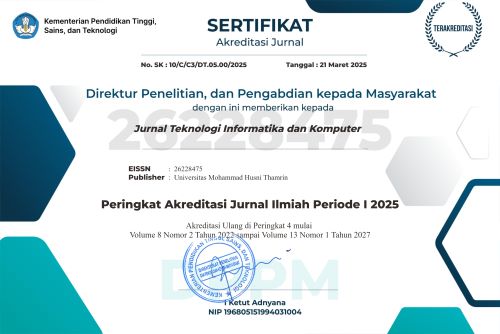
Jurnal Teknologi Informatika dan Komputer allows readers to read, download, copy, distribute, print, search, or link to the full texts of its articles and allow readers to use them for any other lawful purpose. The journal allows the author(s) to hold the copyright without restrictions. Finally, the journal allows the author(s) to retain publishing rights without restrictions Authors are allowed to archive their submitted article in an open access repository Authors are allowed to archive the final published article in an open access repository with an acknowledgment of its initial publication in this journal.

Jurnal Teknlogi Informatika dan Komputer is licensed under a Creative Commons Attribution 4.0 International License.