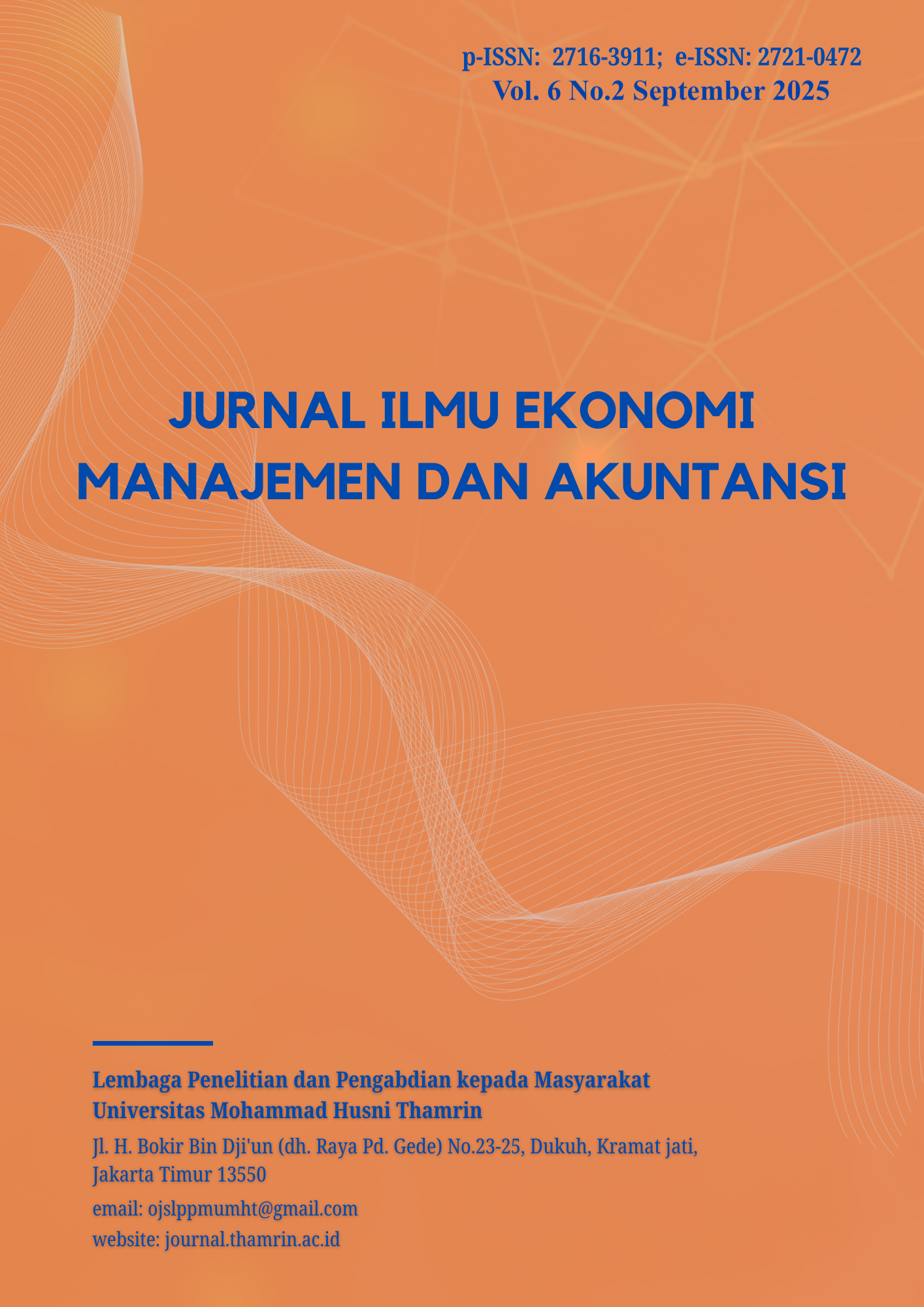
Trust-Based Consumer Responses to Ai Recommendations: Examining Transparency, Purchase Intention, and Digital Skepticism in E-Commerce
DOI:
https://doi.org/10.37012/ileka.v7i2.4064Abstract
Artificial intelligence (AI) has transformed e-commerce by enabling recommendations. However, AI recommendations do not necessarily lead to purchasing decisions. This study examines the influence of AI Recommendation Transparency on Purchase Intention, with Trust as a mediating mechanism and Digital Skepticism as a moderating condition. A cross-sectional survey was conducted among 168 undergraduate students at Universitas Mohammad Husni Thamrin, Jakarta, who had experience using AI-based recommendations. The relationships were analyzed using Partial Least Squares Structural Equation Modeling (PLS-SEM) with SmartPLS 4. The results show that AI Recommendation Transparency significantly influences Trust (β = 0.705, p < 0.001), while its effect on Purchase Intention is not significant (β = 0.104, p > 0.05). Trust significantly influences Purchase Intention (β = 0.610, p < 0.001), indicating its role in translating transparency into purchasing decisions. Digital Skepticism does not significantly moderate the relationship between AI Recommendation Transparency and Purchase Intention (β = 0.062, p > 0.05), but significantly moderates the relationship between Trust and Purchase Intention (β = 0.149, p < 0.05). These findings indicate that transparency alone is insufficient to generate purchase intention; its value emerges when it builds consumer trust. The study highlights the importance of explainable, credible, and responsible AI systems.
Downloads
Published
Issue
Section
Citation Check
License
Copyright (c) 2026 Jaka Trio Setiawan, Ependi, Hasan Basri Basri

This work is licensed under a Creative Commons Attribution 4.0 International License.
Jurnal Ilmu Ekonomi Manajemen dan Akuntansi (ILEKA) Universitas Mohammad Husni Thamrin allows readers to read, download, copy, distribute, print, search, or link to the full texts of its articles and allow readers to use them for any other lawful purpose. The journal allows the author(s) to hold the copyright without restrictions. Finally, the journal allows the author(s) to retain publishing rights without restrictions Authors are allowed to archive their submitted article in an open access repository Authors are allowed to archive the final published article in an open access repository with an acknowledgment of its initial publication in this journal.

Jurnal Ilmu Ekonomi Manajemen Akuntansi (ILEKA) Mohammad Husni Thamrin is licensed under a Creative Commons Attribution 4.0 International License.